San Bruno Amateur Radio Club
Serving the Bay Area since 1958
Serving the Bay Area since 1958
 First pardon our dust. After several years, we've decided to do a little remodeling on the website to bring it up to more modern standards. We've asked our new buddy Claude to help out and he's been very helpful. Right now not everything is working right but shortly we expect things to not only be working but working better than ever. So stay tuned as they say and again pardon our dust.
The SBARC is open to all licensed Amateur Radio Operators, and those with an interest in Amateur Radio. Part of our mission is to provide radio communications to the City of San Bruno in a time of need. We operate the radio room at City Hall, and other designated locations. We have monthly meetings, where we discuss Amateur Radio topics and other related items. We participate in training exercises and drills. Occasionally, we have social dinner meetings with other clubs.
| Date | Event | Start Time |
|---|---|---|
| October 28, 2026 | Our Weekly HF Net | 8:30 PM |
| November 2, 2026 | Our Weekly Net | 7:30 PM |
| November 4, 2026 | Our Weekly HF Net | 8:30 PM |

Mondays at 7:30 p.m. Pacific (1930 HRS), the club conducts nets on:
Wednesdays* at 8:30 p.m. Pacific (2030 HRS), the club conducts an HF net on:
The purpose of these nets is to test equipment and locations around San Bruno, as well as to stay in touch with other club members. Visitors are always welcome to check in.
| Day | Time | Sponsor | Output | Input | Tone | Type | Name |
|---|---|---|---|---|---|---|---|
| Tuesday | 09:00 AM | 9am Talk Net | 145.2300 | 145.8300 | 100.0 | repeater | N6NFI |
| Tuesday | 11:00 AM | California Amateur Radio Service Ne | 7.2480 | 7.2480 | HF-LSB | ||
| Tuesday | 11:30 AM | The Noontime Net | 7.2840 | 7.2840 | HF-LSB | ||
| Tuesday | 9.00 AM | Maritime Mobile Service Network | 14.3000 | 14.3000 | HF-USB | ||
| Tuesday | 7:00 PM | San Mateo Radio Club | 145.3700 | 145.9700 | 107.2 | repeater | N6ZX |
| Tuesday | 7:00 PM | South San Francisco Net | 443.6500 | 448.6500 | 100.0 | repeater | N6SSF |
| Tuesday | 7:00 PM | Youth Net (under 18) | 145.2300 | 145.8300 | 100.0 | repeater | N6NFI |
| Tuesday | 7:15 PM | Foster City ARES | 147.5700 | 147.5700 | simplex | FC1 | |
| Tuesday | 7:30 PM | Burlingame-Hillsborough | 146.8050 | 147.4050 | 192.8 | repeater | BURL V |
| Tuesday | 7:30 PM | Burlingame-Hillsborough | 147.5250 | 147.5250 | simplex | BURL 1 | |
| Tuesday | 7:30 PM | Burlingame-Hillsborough | 146.5950 | 146.5950 | simplex | BURL 2 | |
| Tuesday | 7:30 PM | Daly City ARC | 146.9250 | 147.5250 | 114.8 | repeater | WA6TOW |
| Tuesday | 8:00 PM | Sheriff's Comm Unit | 146.8650 | 147.4650 | 114.8 | repeater | KC6ULT |
| Tuesday | 8:00 PM | Sheriff's Comm Unit | 146.9250 | 147.5250 | 114.8 | repeater | WA6TOW |
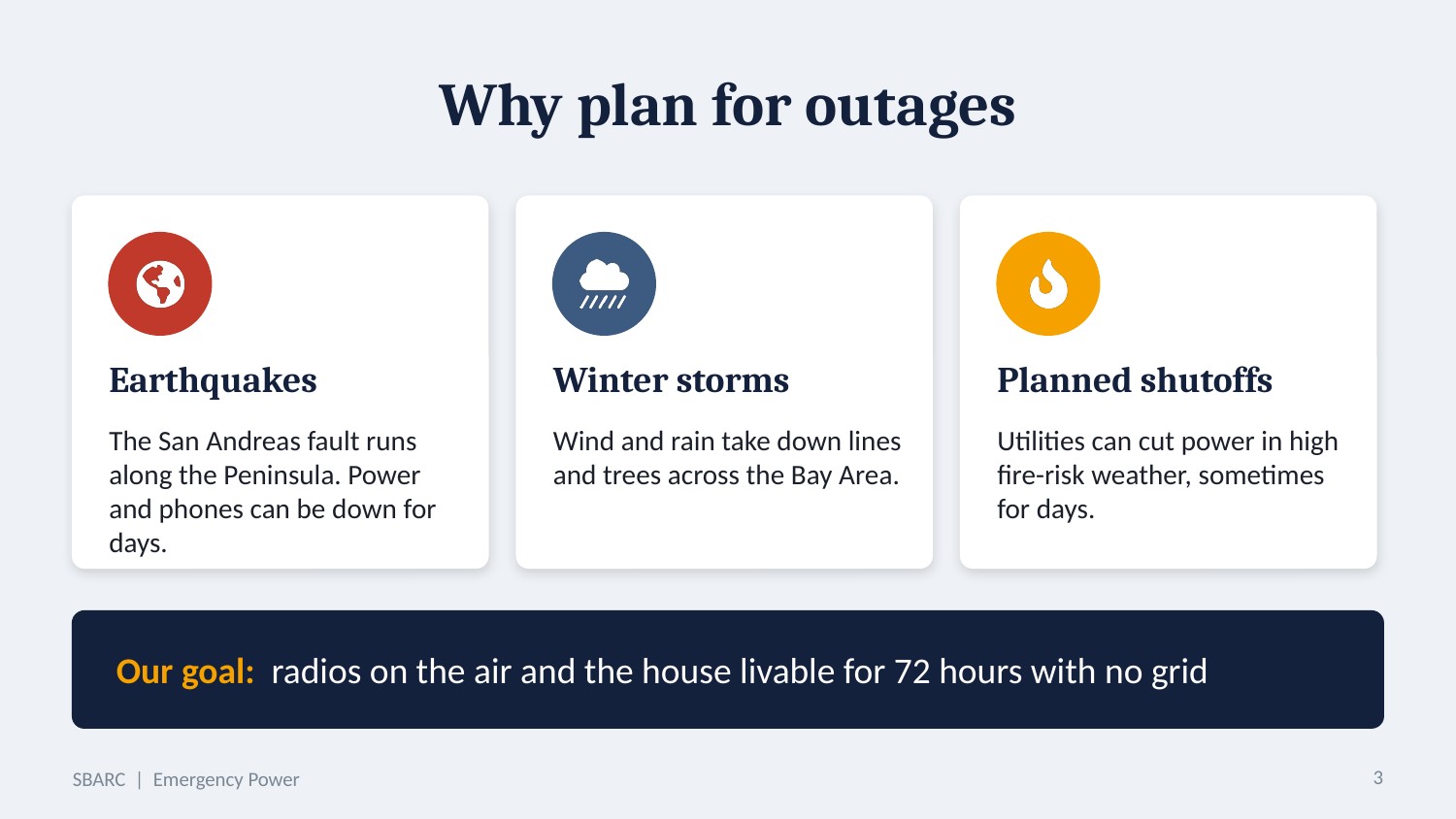 SAN BRUNO — With a strengthening El Niño on the way and neighborhood outages still fresh in members' minds, the San Bruno Amateur Radio Club devoted its October meeting to a question every household faces aswinter approaches: what does it take to keep your radios on the air and your house livable if the power goes out for three days?
Club president Dave Dornlas, KN6KOO, led the evening's presentation, "When the Power Goes... Boo," which ran from the arithmetic of how much power your gear uses to batteries, power stations, generators, solar, and what to run first in the house. Ralph Kugler, KC6YDH, followed with a demonstration of a new free app for digital radio.
Dornlas pointed to the El Niño building in the Pacific, with ocean temperatures in the key region running more than two degrees above normal and forecasters expecting a hard winter. But he stressed that outages do not wait for bad weather. A member in the Shelter Creek area had just been spared an outage that hit some of his neighbors early Sunday morning.
 Amateur Radio is a very rewarding hobby, but it's also one of the few hobbies that require a license. Every Ham operating today has passed a license exam that allows them to be granted a license from the Federal Communications Commission (the FCC).
The good news is it's very doable and particularly since the requirement to learn Morse code was dropped in 2007. And it's a hobby for all ages. The youngest known Ham in the United States was a young lady of 5 1/2. That's amazing, but it should be reassuring that all the family can join in this hobby.
Today, there are three license classes: The Technician, General and the Amateur Extra Class. With each class the operator gains more privileges in using the available airwaves. Read more
We've put together a great library of resources to help you find just what you're looking for.